





Sawyer Inc. All rights reserved.



Repellents
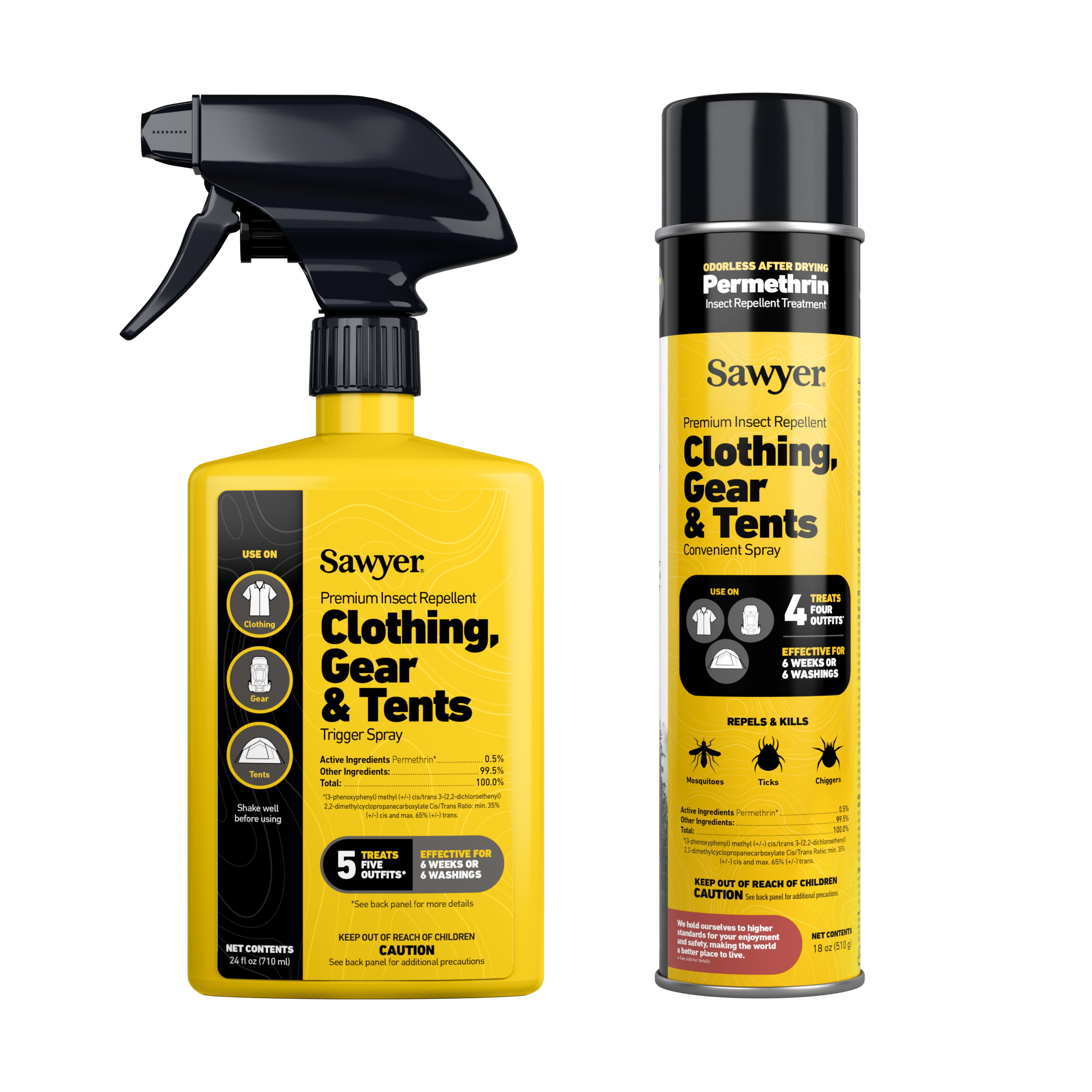
Sawyer Permethrin Insect Repellent Treatment is an insect repellent similar to the natural pyrethrins produced by the flowers of pyrethrums (like Chrysanthemum flowers) and can be applied to clothing, gear, and fabric for long lasting protection.
How to use.
The more Permethrin treated fabric surface area you have near you, the more protected you will be from mosquitoes and ticks. This fabric insect repellent can be used to treat clothing, footwear, workwear, bibs, canvas, work stations, seat covers, animal beds, hammocks, chairs, tents, and other fabrics.
Videos
Frequently Asked Questions
To apply Sawyer Permethrin, follow these step-by-step instructions for clothing and gear:
Preparation • Location: pick a well-ventilated area protected from the wind • Shake well before use, Permethrin tends to separate • Garment set-up: lay items out or hang them up, do not treat clothing while it is being worn
Application • Spray Technique: Hold the bottle upright 6–8 inches from the fabric surface. • Motion: Use a slow, sweeping motion to lightly moisten the surface of the fabric. • Timing: Treat each side of a garment (front and back) for approximately 30 seconds. • Coverage: Fabric should be well-dampened, often indicated by a slight color change or darkening, but does not need to be dripping wet. • Dosage Guide: Use approximately 4.5 oz. of Permethrin per complete outfit (one shirt, one pair of pants, and one pair of socks).
Drying and Storage • Allow items to fully air dry for at least 2 hours or longer, until fully dry. • Heat Bonding: While you should not put wet treated items in a running dryer, you can speed up drying by pre-heating an empty dryer, turning it off, and then placing the items inside. This heat helps the bonding process. • Extending Life: Store treated clothing in black plastic bags between uses to protect it from air and sunlight, which can extend its effectiveness.
Safety Notes • Skin Contact: Do not apply Permethrin directly to skin, face, or eyes. It is for clothing and gear treatment only • Pets: Permethrin is safe for dogs but is toxic to cats until it has completely dried. • Re-treatment: Retreat items after 6 weeks or 6 washings to maintain protection.
Permethrin is a synthetic version of the Chrysanthemum flower’s natural insect repellent pyrethrin. The naturally occurring version breaks down rather quickly in sunlight but Sawyer’s pharmaceutical grade, synthetic Permethrin can last 6 weeks or 6 washings on clothing and other fabrics, making it a fantastic odorless barrier of protection from mosquitoes and ticks.
No. Permethrin will not damage clothes or equipment. Unlike DEET, which may harm some fabrics and materials, Permethrin is compatible for use even on fragile fabrics such as silk, plus all synthetics and waterproof membrane fabrics. Permethrin will not affect plastics or finishes. IF IN DOUBT, try a sample on an obscure surface area, especially on delicates and check it after 24 hours of exposure.Sawyer® Permethrin Insect Repellent is odorless, non-greasy and non-staining after it dries. Permethrin can be harmful to aquatic creatures such as fish, so do not spray Permethrin around fish aquariums.
Spray the object, let it dry, spray again, let it dry, and spray again. If unabsorbed Permethrin drips off of the garment, catch the drippings and reuse. Apply as evenly as possible until the application is fully absorbed.
If you’re water proofing your own clothing, apply the water repellent first, then apply Permethrin using the process above.
It is recommended that treating clothing with the permethrin aerosol be performed outdoors. If the treatment is accidentally carried out indoors, no adverse health effects are expected based upon calculations of inhaled dose. However, individuals with breathing problems, such as asthma, may be at greater risk. The odor arising from treating fabric with permethrin is mostly from the aerosol propellants rather than from the insect repellent itself.
A strong bond is formed between Permethrin and most fabrics. In fact, some insect repellency was observed in military uniforms following 50 launderings. However, the uniforms were treated using an absorption method instead of the aerosol can. In studies performed by the U.S. Army, about 20 to 30 percent of the permethrin treatment was removed after the first laundering. Thereafter, about 3 to 5 percent was lost to each cycle through ten launderings.
Studies in animals have demonstrated that no skin irritation or sensitization is expected following direct application. In a controlled human study, permethrin did not cause significant skin irritation or sensitization when tested in 200 subjects. No significant skin effects are expected from wearing permethrin-treated clothing.
The pump spray version of our Permethrin Insect Repellent Treatment will not harm flame retardant garments.
Yes, you can spray your clothing/gear with Permethrin outdoors, in a garage or in a storeroom and then bring them in to dry. If the sprayed items freeze, they will need to thaw out and completely dry before using/wearing in order for the Permethrin to bond to the fabric. You can also spray them in your house, just ventilate the area by opening a window or door and leave the room for a bit as you would not want to breathe it in.
Depending on the humidity, it should take between 2 to 4 hours to dry. Do not ever put them in your dryer when it is running, but to speed up the drying process, you can run your dryer while it is empty to heat it up, then shut it off and put your clothes in the warm dryer and leave them in there until dry. If necessary, you can repeat this process. The heat actually helps the bonding process and extends the life of the product.
Yes, Sawyer Permethrin is family-friendly. When fully dry and used as directed Sawyer Permethrin is safe for use around babies, pregnant women, and children. The Sawyer Foundation even equips global non-profits with Permethrin Baby Wraps, which reduces malaria infections in infants by 66%.
Permethrin should not be applied near cats or aquatic animals. Cats have a very unique and sensitive central nervous system, and you never want to apply it to them or even spray it near them during the application process. However, once the treated clothing, gear, or fabric has fully dried, it is completely safe to wear/use around cats.
To treat your dog, first put a glove on one hand and spray with the other hand while fluffing dog hair, starting at the tail and moving toward the collar area. Spray rapidly to make sure the entire body is covered. Do not spray into the eyes and face - instead, spray a washcloth and wipe it. Pay special attention to the collar area, dog pit areas, and paws, as that is likely where a tick will try to attach. The dog does not have to be fully soaked. Avoid contact with genitalia. If the dog is super short-haired, you can also spray on a washcloth and wipe it on. For extra protection, you can spray your dog's bed, blanket, jacket, etc. It will last 5 weeks for mosquitoes and flea control and 6 weeks for ticks and other insects. Make sure to apply well before bedtime so that the product has time to dry. Do not use on puppies under 12 weeks.
For more instructions, please visit www.sawyer.com/dogs


